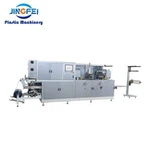
In the process of polypropylene thermoforming, the uniformity of product thickness directly influences the mechanical properties, appearance quality and compatibility of the finished product. Due to the low thermal conductivity and significant crystallinity polypropylene materials, defects such as uneven local thickness and wrinkling of edges are likely to occur during thermal molding. In this paper, the product thickness control strategy in PP thermoforming machine production is systematically expounded from three dimensions: process parameter optimization, mold design improvement and intelligent equipment upgrade.
Precise Control of Process Parameters: Temperature-Pressure-Time Coordinated Optimization
1.Heating Temperature Gradient Control
The PP thermoforming temperature range from 160 to200 degrees Celsius and requires dynamic adjustment according to the complexity of the product structure. For shallower containers, double-sided uniform heating is achieved through infrared heaters using a low-temperature melt phase vacuum of 165-175°C to avoid local overheating and material degradation. For example, the heating time of a 2mm slab should be limited to 90 seconds. For every 0.5mm increase in thickness, the heating time extended by 15 seconds, while surface gloss observed-uniform gloss indicates sufficient heating; localized whitening requires additional heating; and
For deep cavity products, a high temperature solid-state pressure molding process is required at 180-190° C. Compressed air is used to press plates into molds. Air pressure must be controlled in stages: 0.3-0.6MPa for general products and 0.8-1.2MPa for deep chamber products, ensuring that the material fills all corners of the die.
2.Cooling and Shaping Time Matching
The cooling time is 1.5 times longer than the heating time, and for thick-walled products, the cooling time needs to be doubled. Use a combination of air and water cooling: first, cool the product to below 80 degrees Celsius to prevent deformation, and then spray water the product to below 40 degrees Celsius. For example, a 3mm thick product requires 270 seconds to cool down. During this period, uniform cooling is achieved through internal cooling channels (8-12mm in diameter and 30-50mm spaced apart) to prevent thickness deviations due to shrinkage differences.
3. Demolition Time and Method
Demolition too soon can lead to product collapse, and removal too late can make it more difficult. When using an ejector, it is recommended that ejection speed be controlled at 5-10mm/ s. For complex molds, silicon-based release agent that meet FDA standards can be sprayed. Check product thickness immediately after removal and use calipers to measure key areas such as edges, corners and bottom. thickness tolerance should be within ±0.1mm.
Mold Design Innovation: Structural Optimization and Material Upgrade
1. Improved Mold Venting System
In the process of molding polypropylene materials, local dilution is easy to occur due to poor venting. mold vent holes shall be of a diameter of 0.1-0.3mm and vents shall be of a depth of 0.05-0.1mm to ensure smooth discharge of gases. For example, in the manufacture of deep-cavity containers, annular exhaust slots spaced 50mm apart can be added to the sidewall of the mold to prevent air bubbles from causing thickness imbalance.
2. Pre-stretching and Auxiliary Molding Technology
For products with a high draw ratios (such as beverage cups), mechanical pretensioning is used to aid molding: preheated sheets is pressed against the top surface of the mother die and drawn down through a plunger 70% -90% of the mold cavity volume). At the same time, compressed air is injected through the vent hole of the plunger to ensure that the material is uniformly attached to the die. The process can improve the product bottom thickness uniformity by 30% and reduce the crease rate to below 5%.
3. Mold Material and Surface treatment
High hardness die steel (e.g. H13) with hard chromium or nitriding (hardness up to HV900-1000) is used to reduce dimension bias due to wear. For transparent polypropylene products, mold cavity need to be polished to less than Ra0.8 micron to avoid surface scratches that lead to stress concentration and variations in local thickness.
Intelligent Equipment Upgrade: Data-driven, closed-loop control
1. Real-time monitoring and Feedback System
Key parameters (heating temperature curve, molding pressure, cooling time, etc.) were collected using the MES system and monitored throughout theprocess through a network of sensors. For example, infrared temperature sensor are installed in the heating zone to automatically adjust heating power when the plate temperature deviation exceeds ±5°C, and pressure sensor are embedded in the die to provide real-time feedback on molding pressure and ensure that the deep cavity is adequately filled.
2. Automatic Feeding and Removal System
A six-axle robotic arm is used instead of manual operation, feeding speed can reach 3 m/min, positioning accuracy ± 0.05mm, avoiding the displacement of plate caused by manual clamping. In the process of disassembly, the robot arm is three times faster than manual operation, and the pass rate rises to 99.5%, greatly reducing thickness anomalies caused by disassembly damage.
3. Digital Twin Technology
A virtual simulation platform for molding defects based on CAE analysis is introduced. For example, when developing new automotive interior components, the product wall thickness deviation was reduced from ± 0.2mm to ± 0.08mm by simulating material flow paths under different process parameters and optimizing mold flow channel design, resulting in a 40% reduction in the test mold cycle.
Conclusion:
The control of Controlling product thickness in PP thermoforming machine production requires concerted efforts from three aspects: process, mould and equipment. By precisely controlling hot and cold parameters, optimizing die ventilation and pretensioning structure, and deploying intelligent monitoring system, the uniformity of product thickness can be significantly improved. With the popularization of new technologies such as digital twin and multilayer coextruding plate, PP thermoforming technology will develop in the direction of high accuracy and efficiency, providing better solutions for food packaging, automobile parts and so on.