

Blister Packaging Machine
Jingfei: Leading Blister Packaging Machine Manufacturer In China
Wenzhou Jingfei Plastic Machinery is located in Wenzhou Ruian, one of mostly famous Mechanism city. Our company is a technology innovation firm, including machine designing, spare parts manufacture, installment, commission, and mold designing etc
Our company use modern professional management. During the processing, we hardly control the quality, reject all disqualification parts. During the marketing and after service, we give the best advise of our clients, help clients to built a good marketing, increasing the competition on our clients.
Wide Range of Applications
Our products are used in many filed, such as PP,PS,PVC,PET, food container, lid, cups, plastic trays, plate, fruit boxes, egg tray boxes, seed nursery plate, display trays, cosmetic trays, pharmaceutical trays.
Wide Production Market
Our machine widely sale to USA, Greece, Serbia, Indonesia, Vietnam, Malaysia, Middle east, South America.
Quality Assurance
We have professional equipment to ensure products quality, such as Radial drilling machine, turning machine, CNC milling machine, grinder and polish. And we have one year warranty time. During these time, if all the mainly machine parts were broken, we will change the new parts for free.
After-Sales Service
We supply 24 hours on line after service. We also send the engineer to clients work shop for installment and commission the machine.
Introduction of Blister Packaging Machine
Blister packers are special equipment which are utilized to package tablets in units of doses capsules, tablets, and so on. The machine is comprised of a bubble package which could be a pocket or cavity composed of a formable film, which is usually made of hot-formed or thermoformed aluminium film. The majority of them have a lidded closure made of aluminum foil.
This is an electromechanical apparatus which has both moving and stationary components that assist in sealing and packaging products inside pre-formed cavities.
The mechanical motions facilitate the creation of cavities of the right size on the packaging material for filling, sealing, and sealing using appropriate materials.
Using different packaging materials and principles of forming, Blister Packs could also be divided into three types:aluminum/plastic (thermoforming) bubble pack, aluminum/aluminum (cold forming) bubble pack, and aluminum/plastic/aluminum bubble pack.
-
 Horizontal Type Blister Packing MachineIt is suitable for paper plastic packing of such products as cakes, injection, injectors, toy cars,Add to Inquiry
 -
 Paper Plastic Blister Packaging MachineIt adopts concave and convex die/positive/negative pressure integrated molding, aircraft holeAdd to Inquiry
 -
 Paper PVC Blister Thermoforming MachineApplicable to paper and plastic packaging of hardware, medical equipment, toys, batteries,Add to Inquiry
 -
 Blister Thermoforming Machine for BatteryIt is suitable for paper plastic packing of such products as cakes, injection, injectors, toy cars,Add to Inquiry
 -
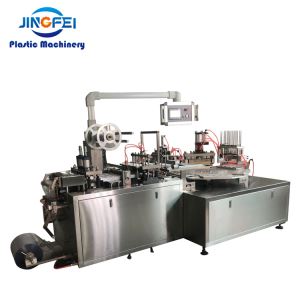 Paper Clamshell Blister Forming MachineJH 350 Paper clamshell blister forming machine is widely use in Hardware , Pharmaceutical , dailyAdd to Inquiry


Benefits of Blister Packing Machines
Dosage/Serving Size
The packages in medicines and certain foods evenly portion out an item so that the consumer doesn't use too much of the product at once. A few seasoning blends benefit from blister packs as the company has already decided the amount required for certain recipes. Hence, medicine dosing is easier to understand and safer for the consumer when this type of package is used.
Security
Blister packaging is the perfect solution for products that need to stay immobilized, as the individualized and usually small compartments don't allow the products to move within the packaging. In other terms, the design looks after items from damage caused in transit.
Customized
As is widely recognized, the process of thermoforming is employed in the creation of all plastic blisters. Consequently, each design is specifically tailored to accommodate the product it encases. This means that regardless of the size or number of items contained within a blister pack, it can be customized to fulfill the specific requirements of any product.
Increased Visibility
Containers featuring transparent plastic fronts enable customers to visually inspect the product prior to purchase. This design ensures that the contents are as advertised in terms of quantity and completeness. While these containers allow for visual verification, they restrict physical access, thereby safeguarding the product against tampering and theft.
Types of Blister Packaging Machines
Rotary Blister Packaging Machine
A high-speed machine that uses a rotating sealing system to create blister packs. It is usually used for mass production.
Flat Blister Packaging Machine
A machine that uses heat sealing technology to produce flat blister packaging. It is suitable for packaging smaller items and is often used in the pharmaceutical industry.
Thermoforming Blister Packaging Machine
This machine forms blisters by heating and shaping plastic sheets on a mold. It is commonly used in packaging food and consumer goods.
Blister Sealing Machine
A semi-automatic or automatic machine that uses heat sealing or ultrasonic sealing technology to seal preformed blisters. It is used to seal blisters made by other machines.
Skin Packaging Machine
A machine that uses heat and pressure to form a clear plastic film on a card or product on a tray. This type of packaging is often used to display products in a retail environment.
Materials Used in Blister Packing Machine
Packaging Film
Rigid plastic films like cellulose, vinyl resin, polystyrene, polyvinylidene chloride, polyvinyl chloride, and polystyrene, etc, can be used for blister packaging. Currently, the most widely used pharmaceutical blister packaging material is PVC plastic sheet because of its good barrier performance against light, water vapor, and the unusual smell of plastic sheet.
Substrate
White cardboard is usually used for blister packaging. It's made of bleached kraft wood pulp, or can be made with the recycled board covering the base layer with white paper. The size, shape, and quality of the cardboard are considered when using the white cardboard. The thickness range of the whiteboard substrate is 0.35-0.75mm, while it is 0.45-0.60mm for the normally used board. Also, make sure that the substrate surface is white and glossy, with good quality printability, and that the heat-sealing coating can be firmly coated. Make sure that the substrate and blister are combined closely after the heat seating coating is melted, to prevent the contents from falling out.
Coating Material
The coating material should be compatible with the substrate and the blister. Besides, the temperature should be relatively low so that it can be sealed quickly without damaging the blister film.
Troubleshooting Issues With Blister Packaging Machine
Material Thickness Variation
The integrity of the package to form a whole barrier around various products could be affected. Besides, the quality of the materials could lead to the variation in material thickness. This can be resolved by considering a uniform material thickness and running the machine accordingly.
Inappropriate Sealing
An inappropriate sealing can result in the peeling off of the seal from the PVC. Inadequate heating and pressing forces are the main causes of this problem.
Missing Products in the Cavities
The reason could be because of the faulty parts of the machine or the high-speed filling of parts into the cavity. This can be resolved by fixing the broken parts such as turning the roller for proper filling of cavities. Also, the speed of the turning rollers from the control panel can be adjusted for better handling.

The Productivity of the Blister Packaging Machine
This entirely depends on the number of packages a blister packaging machine can handle within a certain time. Consider a machine that will fit the output needs of your production system.
Power and Air Pressure Requirements
Includes the quantity of energy that the machine needs to perform certain functions. The air pressure requirements will decide the amount of force you need to seal the materials thoroughly.
Material Specifications
See for a machine that allows you to change the material types as much as your production requirements demand.
Automation level
Depending on the cost, the automation level will be decided if you are going for a manual or automatic blister packing machine.
Our Factory
Common Problems of Blister Packaging Machine
We're well-known as one of the leading blister packaging machine manufacturers and suppliers in China. Our factory offers high quality blister packaging machine made in China with competitive price. Welcome to contact us for customized service.
We guarantee to give you a timely reply, and look forward to working with all merchants to grow together, through joint efforts, to provide the best quality Air Chiller Cooling Machine, thermoforming machine diy, Plastic Granule Lift Machine for you.