

Extruder Machine
Jingfei: Leading Extruder Machine Manufacturer In China
Wenzhou Jingfei Plastic Machinery is located in Wenzhou Ruian, one of mostly famous Mechanism city. Our company is a technology innovation firm, including machine designing, spare parts manufacture, installment, commission, and mold designing etc
Our company use modern professional management. During the processing, we hardly control the quality, reject all disqualification parts. During the marketing and after service, we give the best advise of our clients, help clients to built a good marketing, increasing the competition on our clients.
Wide Range of Applications
Our products are used in many filed, such as PP,PS,PVC,PET, food container, lid, cups, plastic trays, plate, fruit boxes, egg tray boxes, seed nursery plate, display trays, cosmetic trays, pharmaceutical trays.
Wide Production Market
Our machine widely sale to USA, Greece, Serbia, Indonesia, Vietnam, Malaysia, Middle east, South America.
Quality Assurance
We have professional equipment to ensure products quality, such as Radial drilling machine, turning machine, CNC milling machine, grinder and polish. And we have one year warranty time. During these time, if all the mainly machine parts were broken, we will change the new parts for free.
After-Sales Service
We supply 24 hours on line after service. We also send the engineer to clients work shop for installment and commission the machine.
Introduction of Extruder Machine
At its core, an extruder machine is a specialized device used to process materials by pushing them through a die to create a specific shape or form. The process involves subjecting the raw material to controlled pressure and temperature within the machine, resulting in the material being forced through a die orifice to form the desired product. Extruders are capable of handling a diverse array of materials, including plastics, metals, ceramics, and food ingredients, making them invaluable tools in various manufacturing settings.
-
 Automatic PS PP Extruder LineWe adopt advanced international technology and make considerable innovations on design,Add to Inquiry
 -
 Single Layer Plastic Sheet Extruder Machine1.The bracket is welded by Q235-A, the national standard steel . 2.Edge cutting device: two cuttingAdd to Inquiry
 -
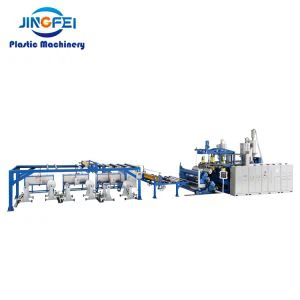 Single Screw Plastic Granule Extruder LinePower supply:AC480V±10% 50Hz 3P+E . Compressed air:0.5~0.8Mpa(DP≤10℃) . Cooling water:≤30℃Add to Inquiry
 -
 Small Capacity PP PS Extruder MachineAPPLICATION AREA The sheet extruder is composed of extrusion, calendaring, traction and rolling.Add to Inquiry
 -
 Big Capacity Recycle Plastic Granule Extruder LineThe Big Capacity Recycle Plastic Granule Extruder Line is composed of extrusion, calendaring,Add to Inquiry


Single Screw Extruder: Single screw extruders are the most common type, best suited for the extrusion of pure polymer. They consist of a single screw rotating within a cylindrical barrel. The screw transports the plastic granules from one end of the barrel to the other, heating and melting them in the process. The molten plastic is then forced through a die, which shapes it into a continuous profile.
Twin Screw Extruder: Twin screw extruders, on the other hand, have two parallel screws rotating in the same or opposite directions. This design improves mixing and allows for the use of a broader range of materials, including the addition of fillers and reinforcements. These extruders can be further classified into co-rotating and counter-rotating variants based on the direction of screw rotation. Twin screw extruders are typically used for more complex applications where better mixing or compounding of materials is required
Continuous Production: Extruder machines continuously process plastic raw materials to produce final products. This ensures that products are consistently delivered to markets in demand, boosting business revenues.
Efficiency and Cost Savings: Continuous operation of extruder machines reduces operating costs. Stopping and restarting the machine can lead to time loss and increased energy consumption. Continuous production optimizes energy and material usage.
Product Quality: Running the machine at a constant speed during the extrusion process enhances product quality. Interruptions can lead to quality issues in the products.
Customer Satisfaction: Continuous production enables faster and more reliable responses to customer demands. This, in turn, increases customer satisfaction and strengthens customer loyalty.
Waste Reduction: Uninterrupted machine operation helps in reducing the amount of waste generated. Decreasing waste material costs while increasing environmental sustainability.

Hopper cylinder – It is made of cast steel and is jacketed for water-cooling. The insides are made wear resistant by chrome plating or nitrited alloy steel. The insides also have spiral undercuts for high feeding efficiency.
Rollfeeder – The feed roll is operated by the screw by the means of a gear and pinion. The feed roll surface is hardened and an inside chamber for tempering fluid is provided.
Forward cylinder – The cylinder is made of nitrited alloy steel (for high wear resistance) and peripheral drilling for circulating tempering fluid is provided. Sometimes, bi – metallic linings are given. The pins are made of high grade alloy steel hardened fro greater wear resistance.
Screws – The twin screws are made of cast steel and are chrome plated. They are usually bored for cooling. The diameter of normal screws is 60 – 200 mm with a length of 5 – 20 times the diameter.
The functions of the screw are manifold – Mixing, blending, homogenizing, dispersing, compounding, degassing. Twin screw extruders are the most commonly used extruders. They can either be intermeshing or nonintermeshing. Nonintermeshing extruders behave like two single screw extruders with only minor interactions between the two screws. Another classification is the direction of rotation of screws. Co – rotating screws have both screws rotating in the same direction and the material exchanges from screw to screw.
On the other hand, the counter – Rotating screws have material transported through the extruder in a figure eight channel.
Feeding screws – They are made of high alloy steel and polished, nitrited or satellite on their tips. They are also drilled for tempering fluid circulation.
Dies – Many special arrangements of extruder dies are used for composite layered sheets. Two types of rubber enter the die from two extruder barrels and exit as one sheet. The top and bottom layers are of different materials.
The mixing chamber – The chamber which contains the screws and where the actual mixing takes place. This region is the region of maximum power consumption as well as maximum temperature rise. The throughput of an extruder is typically ~ 400 kg/hr.
Vacuum zone – A vacuum zone inside the cylinder is created by the use of screws with high thread height. This is done to vent the rubber from inclusions of gases to eliminate porosity.
Extruder tempering system – Usually it is a closed circuit type with electrical heating.
Both single – and twin – Screw extruders may use hot oil circulation systems for temperature regulation. The sump temperature is set to 204 degrees, and the extruder barrel is heated or cooled depending upon internal heat generation. Circulation may be constant (no temperature controllers) or may be adjusted to control individual zone temperatures.
Gear reducer – The screw speed varies normally from 30 – 60 rpm. The gear reducer reduces the motor speed to this speed. They are usually provided with forced feed lubrication system.
Thrust bearings – They form an integral part of the extruder system. Optimized design for long life at the maximum extrusion pressure and screw speed.
The extruder has a pair of screws and a screw sleeve, which have the functions of mixing and kneading. After the raw material enters the extruding cavity, the material is subjected to extrusion, friction, shearing, and other effects between the screw sleeves, and the internal pressure continues to rise, up to 4Mpa, and the temperature continues to rise, up to 140 degrees Celsius. Within 3-7s, the temperature and pressure rise sharply, and the tissue structure of the material changes, which further gelatinizes the starch, denatures the protein, destroys the crude fiber, and kills harmful bacteria such as Salmonella. The high-temperature and high-pressure material come out of the discharge port, and its pressure is suddenly released in an instant, and the moisture is partially flashed.

The Applications of Extruder Machine in Processing Industry
PET PLA PBAT Sheet Extrusion
Use in producing PET / PLA sheets, no need pre-drying crystallization of the energy consumption and adapt to the material for the production of the second, high yield, low energy consumption, high-quality plastics characteristics.
Long Glass Fiber Reinforced Thermoplastic Composites Impregnation Extrusion
It is not simply coating fibre tows with polymer, inside impregnation mould individual filaments in the fibre tows are spread apart so each is encapsulated with thermoplastic polymer.
Underwater Pelletizing
For example:
Reinforced modification: PP, PA, PBT, ABS, AS, PC, POM, PPS, PET, PPO, PSF, LCP add. Glass Fiber;
Filling Modification: PE, PP, EVA etc.+ talcum powder, titanium dioxide, carbon black;
Cable material: LDPE, HDPE, LLDPE, MDPE, sheath material, insulating material;
Blend alloy: PC+ABS, PA+ABS, CPE+ABS, PP+EPDM, PA+EPOM, PP+SBS;
Colour masterbatch: PE, ABS, PS, EVA, PET, PP+pigment, additive etc;
Flame retardant masterbatch: PP, PA, ABS, EVA, PBT+ flame retardant, additive etc;
Biodegradable masterbatch: PP, PE, PS+starch, additive etc.
Pipeline
Large size water supply lines for connection to water sources, water treatment plants and drinking water reservoirs, smaller size domestic water supply lines.
Large size mains for gas supply networks. Smaller size domestic gas supply lines.
Various types of panel and underfloor heating systems, hot and cold water installations, and acoustic drainage systems in buildings.
Cable pipe
The cable industry uses plastic tubing almost exclusively for the protection of power lines and cables used for data transmission, control systems and telecommunications systems against external shocks.
PVC is an extremely versatile material and is generally supplied as a dry (powder) mix, as in the case of PVC processing. The PVC compound is sensitive to shear and high temperatures, so it is gently processed with a parallel or conical twin-screw extruder, depending on the required output and pipe size.
The most commonly used 3-layer tube system is the core foam tube with a foam intermediate layer. The foam layer reduces the total weight of the pipe by 25 %. In addition, recycled material can often be used for the intermediate layer of core foam and solid wall tubes.
3-layer PVC pipes are now being used for a wide range of non-pressure applications such as drainage pipes and cable penetrations.
The Extruder Production of PE-Xa Pipe
PE-Xa (Peroxide crosslinked polyethene) has a very high degree of crosslinking and therefore excellent heat resistance. The manufacture of PE-Xa pipes requires a highly specialised process in which a blend of PE powder, liquid peroxide and stabiliser is melted and homogenised in a twin-screw extruder. To prevent early cross-linking, a low process temperature of 160°C is used for the compounding. Afterwards, the melt is moulded into a pipe blank in a pipe die with optimised flow properties and with a very small amount of special coating.
The Processing of Polyolefin
Polyolefins are generally supplied in the form of pellets. They are particularly suitable for single-screw extrusion because they are only moderately sensitive to shear and thermal stress.
The Modified and Prilling of Material
Extruders can be used for mixing, plasticising and granulating plastics, colouring and blending.
Our Factory
Common Problems of Extruder Machine
We're well-known as one of the leading extruder machine manufacturers and suppliers in China. Our factory offers high quality extruder machine made in China with competitive price. Welcome to contact us for customized service.
For many years, we have been aiming to create excellent quality and high reliability thermal former, Cup Lid Forming Machine Small Size, large thermoforming machine, and regard the needs of users as the basis of our research and development.