

Thermoforming Machine
Jingfei: Leading Thermoforming Machine Manufacturer In China
Wenzhou Jingfei Plastic Machinery is located in Wenzhou Ruian, one of mostly famous Mechanism city. Our company is a technology innovation firm, including machine designing, spare parts manufacture, installment, commission, and mold designing etc
Our company use modern professional management. During the processing, we hardly control the quality, reject all disqualification parts. During the marketing and after service, we give the best advise of our clients, help clients to built a good marketing, increasing the competition on our clients.
Wide Range of Applications
Our products are used in many filed, such as PP,PS,PVC,PET, food container, lid, cups, plastic trays, plate, fruit boxes, egg tray boxes, seed nursery plate, display trays, cosmetic trays, pharmaceutical trays.
Wide Production Market
Our machine widely sale to USA, Greece, Serbia, Indonesia, Vietnam, Malaysia, Middle east, South America.
Quality Assurance
We have professional equipment to ensure products quality, such as Radial drilling machine, turning machine, CNC milling machine, grinder and polish. And we have one year warranty time. During these time, if all the mainly machine parts were broken, we will change the new parts for free.
After-Sales Service
We supply 24 hours on line after service. We also send the engineer to clients work shop for installment and commission the machine.
Introduction of Thermoforming Machine
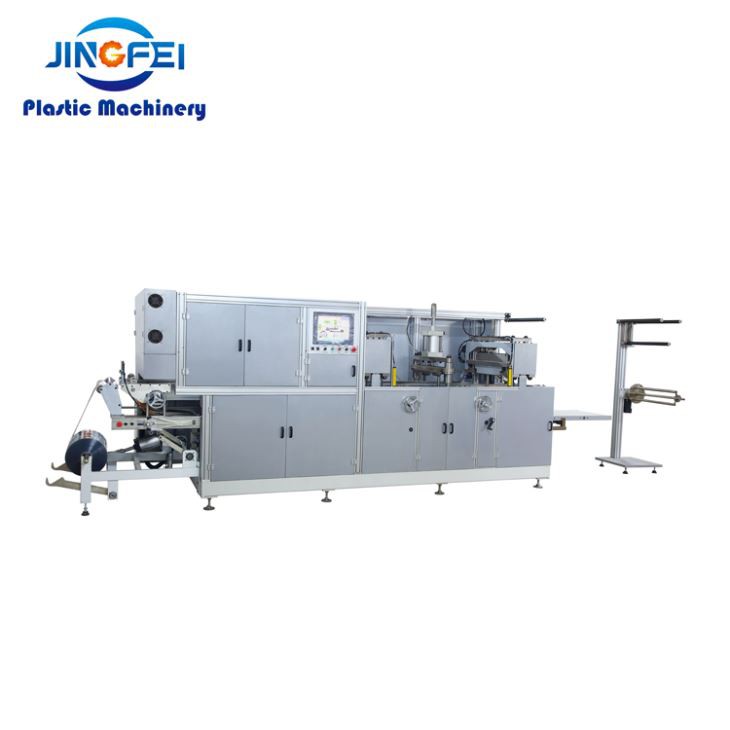
Thermoforming is the process of stretching a heated sheet of plastic over a mold and trimming and assembling the design after the sheet has cooled off to create custom packing solutions. A thermoforming machine is a large piece of manufacturing equipment that enables you to mold a sheet of plastic on an object, while vacuuming the air in between. Various industries utilize and benefit from thermoforming machines to effectively package their goods.
-
 PP Vacuum Forming MachinePP vacuum forming machine could produce many different kinds of disposal plastic products, lid foodAdd to Inquiry
 -
 Plastic Injection Molding MachinePlastic injection molding machines are used to manufacture large quantities of plastic parts.Add to Inquiry
 -
 Cake Tray Forming MachineCake tray forming machine could produce products widely use in food, pharmaceutical, cosmetic,Add to Inquiry
 -
 Large Thermoforming MachineLarge thermoforming machine could help the plastic company to save the human cost, solve theAdd to Inquiry
 -
 Automatic Four Station Thermoforming MachineThermoforming is a pivotal process in the manufacturing sector, and the 4 station thermoformingAdd to Inquiry
 -
 Small Injection Molding MachineSmall injection molding machine is most popular plastic molding machine in the world. Not onlyAdd to Inquiry
 -
 PP Thermoforming MachinePP Thermoforming Machine is the process of stretching a heated sheet of plastic over a mold andAdd to Inquiry
 -
 Injection Moulding MachineAn Injection Molding Machine, sometimes referred to simply as an injection machine, is aAdd to Inquiry
 -
Plastic Injection Molding MachineFully Automatic Thermoforming machine for Egg tray boxes, Food boxes, Fast food boxes . MachineAdd to Inquiry
-
 Pressure Thermoforming MachinePressure Thermoforming machine for PP food box use the air to forming the blister, firming firm andAdd to Inquiry
 -
 Injection Moulding MachineMicrowave Disposable Plastic Meal Lunch Box Thermoforming Machine is mainly produce for PP foodAdd to Inquiry
 -
Automatic Four Station Thermoforming MachineAutomatic Four Station Thermoforming machine is special design for PP and PS PVC Film. This machineAdd to Inquiry


Types of Thermoforming Machines
Vacuum Forming Machine
This type of thermoforming machine uses a vacuum to create the desired shape of the plastic sheet. The heated plastic sheet is placed over the mold, and the vacuum is applied to draw the sheet into the mold cavity, forming the product.
Plug-Assist Thermoforming Machine
Plug-assist thermoforming machines use a plug or plug-assist mechanism to push the plastic sheet into the mold cavity. The plug assists in stretching and shaping the plastic, allowing for more intricate and precise forming.
Twin-Sheet Forming Machine
Twin-sheet forming machines are used to produce hollow or double-walled products. They have two separate plastic sheets that are heated and formed simultaneously. The two formed sheets are then joined together to create a sealed, hollow structure.
Pressure Forming Machine
Pressure forming machines operate similarly to vacuum forming machines, but they also apply air pressure to the backside of the plastic sheet. The combination of vacuum and pressure helps to achieve more complex shapes and sharper details.
Rotary Thermoforming Machine
Rotary thermoforming machines are designed for high-volume production. They consist of multiple stations that rotate in a circular motion. Each station performs a specific operation, such as heating, forming, cooling, and trimming. This continuous rotation allows for increased production efficiency.
Inline Thermoforming Machine
Inline thermoforming machines are a common type of thermoforming equipment. They have a linear configuration, where the plastic sheet is fed through different stations in a straight line. The sheet is heated, formed, cooled, and trimmed sequentially as it moves along the machine.
Benefits of Using an Automatic Thermoforming Machine
Enhanced Efficiency and Productivity
Automatic thermoforming machines operate with remarkable efficiency, minimizing downtime and maximizing output. By automating the entire thermoforming process, from feeding the plastic sheet to trimming the finished product, these machines eliminate manual labor and streamline the production flow. This automation allows manufacturers to produce large volumes of thermoformed products quickly and consistently, meeting the demands of modern markets.
Increased Accuracy and Precision
Automatic thermoforming machines are equipped with advanced control systems that ensure consistent and precise product quality. These machines utilize sensors, actuators, and programmable logic controllers (PLCs) to precisely control the temperature, pressure, and forming process parameters. This level of control minimizes defects, reduces scrap, and ensures that each thermoformed product meets the desired specifications.
Reduced Labor Costs
With the introduction of automatic thermoforming machines, manufacturers can significantly reduce their reliance on manual labor. These machines perform repetitive tasks with precision and speed, eliminating the need for multiple operators. This reduction in labor requirements not only lowers production costs but also frees up skilled workers to focus on more value-added activities.
Improved Safety and Ergonomics
Automatic thermoforming machines enhance workplace safety by eliminating hazardous manual operations. The automation of the thermoforming process minimizes the risk of accidents, injuries, and repetitive stress disorders associated with manual handling of heavy materials. Moreover, these machines often incorporate ergonomic design features to reduce operator fatigue and improve overall working conditions.
Consistent Product Quality
Automatic thermoforming machines provide a consistent level of quality across production runs. By eliminating human error and ensuring precise control over process parameters, these machines produce thermoformed products with consistent dimensions, shapes, and properties. This consistency is crucial for manufacturers who must meet stringent quality standards and regulations.
Reduced Material Wastage
Automatic thermoforming machines minimize material wastage by optimizing the cutting process. These machines utilize advanced nesting algorithms to arrange the product shapes efficiently on the plastic sheet, reducing the amount of scrap material generated. Additionally, automatic trimming systems ensure precise cutting, eliminating excess material and reducing the overall cost of production.
Enhanced Flexibility and Versatility
Automatic thermoforming machines offer remarkable flexibility and versatility, allowing manufacturers to produce a wide range of products with different shapes, sizes, and materials. These machines can easily accommodate changes in product design, enabling manufacturers to adapt quickly to changing market demands. The versatility of automatic thermoforming machines makes them ideal for a variety of industries, including packaging, automotive, medical, and consumer goods.
Parts of a Plastic Thermoforming Machine
- The traditional injection machine uses contact relays to switch various actions. It often fails due to loose contact screws and aging contacts. Usually, new products should be replaced after one million times of use to ensure the stability of the electronic control. In particular, environmental factors such as dust adhesion and humid air will also affect the machine’s operation.
- The modern injection machine adopts a contactless integrated circuit, which greatly reduces the connection of wires, significantly improves the undesirable phenomena caused by the wires, and improves the stability.
- The mechanism of the thermoforming machine should be regularly maintained and lubricated to reduce the coefficient of friction and reduce wear. The nuts and locking screws on the head plate should be checked regularly to prevent the elder pillar from breaking due to uneven force.
- The mold thickness adjustment mechanism should regularly check whether the large gear or chain of the drive shaft is offset or slack. Whether the screw of the pressure plate on the gear is loose, whether the lubricating grease is enough, etc.
- In the hydraulic system, attention should be paid to the cleanliness of the hydraulic oil to maintain the quality of the hydraulic oil. The stable and high-quality hydraulic oil should be used. In addition to regular replacement, its working temperature should be properly controlled below 50C to avoid deterioration. And affect the stability of hydraulic action.
- When the injection molding machine is in operation, if there is any abnormality in the system, the controller will sound an alarm, and a line of warning messages will appear at the bottom of the camp screen.
How Does A Thermoforming Machine Work


Material preparation: The thermoforming machine is set up by loading the appropriate plastic sheet material onto the machine. The plastic sheet can be in roll form or pre-cut sheets, depending on the machine design and requirements.
Heating the plastic sheet: The thermoforming machine has a heating zone where the plastic sheet is heated to its softening point. Various heating methods such as radiant heat, convection heat, or infrared heating elements are employed to heat the plastic sheet evenly and uniformly.
Indexing or feeding the plastic sheet: Once the plastic sheet is heated to the desired temperature, it is advanced or indexed into the forming station of the machine. This can be achieved through mechanical or automated feeding mechanisms that ensure precise positioning of the plastic sheet.
Forming the plastic sheet: In the forming station, the heated plastic sheet is brought into contact with a mold or set of molds. The molds define the shape and contour of the final product. Depending on the type of thermoforming machine, the forming process may involve vacuum forming, pressure forming, or other techniques.
Applying vacuum or pressure: In vacuum forming, a vacuum is applied to draw the heated plastic sheet onto the mold cavity, conforming it to the desired shape. In pressure forming, in addition to the vacuum, air pressure is also applied to help shape the plastic sheet.
Cooling the formed product: After the forming process, the formed plastic product needs to be cooled to solidify and retain its shape. Cooling can be achieved through a combination of air cooling, water cooling, or contact with cooled surfaces, depending on the machine configuration.
Trimming and finishing: Once the formed plastic product is cooled and solidified, any excess material or flash is trimmed or cut away. This can be done manually or using automated trimming mechanisms integrated into the thermoforming machine. Additional finishing operations such as hole punching, embossing, or edge trimming may also be performed as required.
Product removal and handling: The finished thermoformed products are then removed from the machine, either manually or using automation, and are ready for further processing, packaging, or assembly.
- Plastic packaging industry (blister packaging, plastic, batteries, toys, gifts, hardware, home appliances, electronics, stationery, decoration);
- Food packaging industry (fast food boxes, fruit trays, biscuit boxes);
- Pharmaceutical industry (pill packaging, tablet packaging);
- Industrial cooling tower cooling water deflector, etc.;
- Three-dimensional relief patterns for decoration, plastic ceilings, siding, automotive materials, sanitary equipment, and other manufacturing industries.
- Suitable for the production of various color sheets: polyethylene PS, polyvinyl chloride PVC, plexiglass, ABS, polymethyl methacrylate; flocking sheets; environmental protection sheets APET, PET, PP, etc.; photodegradable materials; Plastic products such as biodegradable materials.

These routine maintenance check to ensure that a safer operation of a thermoforming machine should always be carried out monthly. With this, it will be guaranteed that the machine’s parts are all intact and in the right state.
1. Always check to see if fixed guards are held in place using the right fastening material or tool.
2. Always check to ensure that interlocked devices are correctly aligned and in the right attachment to the guards.
3. Always carry out a visual check to ensure that the interlocked guards triggers the any sensor that is attached to a pneumatic, hydraulic or electrical component.
4. Always carry out a routine check to be sure that none of the interlocks or guards have been tampered with.
5. Always be sure that whenever the machine is turned off, devices at the edge of the guard are also turned off without any partial current flowing through them.
6. Always carry out a routine test to ensure that the emergency stop button puts all components of the machine off.
7. Always carry out a visual check to ensure that no electrical wire is exposed or damaged.
8. Always check to be sure that the temperature caution signs are in place and also that the heat insulator is working perfectly.
The first step in selecting thermoforming equipment is to determine the type of thermoforming equipment you are looking for. Depending on your application, you may need a custom thermoforming equipment or off-the-shelf thermoforming equipment with options and accessories.
Also, it is important to have a clear understanding of what type of thermoforming process you are looking to achieve. Vacuum forming, pressure forming, and twin sheet thermoforming all offer unique advantages for specific thermoforming applications, so be sure to assess what your thermoforming needs are before selecting a thermoforming equipment.
Another crucial factor in choosing the right thermoforming equipment is understanding the capabilities of each machine. This can include factors such as thermoforming sheet thickness, machine size, forming area, materials that the thermoformer is capable of handling, and other features. It is important to select a thermoformer that meets your application needs and allows for growth in the future.
Additionally, it’s important to look at the safety and operation of the thermoforming equipment. Be sure to select a thermoforming equipment that has safety features in place, such as guards and sensors. Additionally, consider the overall ease of operation when selecting thermoforming equipment – look for models that are easy to use and maintain.
Finally, it’s important to work with a reputable thermoforming manufacturer to ensure that you get quality thermoforming equipment that meets your needs. A thermoforming manufacturer can provide guidance and assistance in selecting the right thermoforming equipment for your application and ensure that you get quality results every time.
By following these tips, you can be sure to find the thermoforming equipment that is best suited for your specific application. With the right thermoforming equipment, it’s possible to create high-quality thermoformed products with a reliable and consistent result.
Our Factory
Common Problems of Thermoforming Machine
We're well-known as one of the leading thermoforming machine manufacturers and suppliers in China. Our factory offers high quality thermoforming machine made in China with competitive price. Welcome to contact us for customized service.
We are a professional enterprise of manufacturing thermoforming packaging machine, PP Plastic Sheet, used vacuum forming machine, with strong technical force, warm and thoughtful service and novel business philosophy.