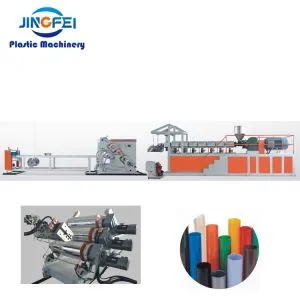
In today's plastics processing industry, PP thermoforming machines hold a pivotal position. Polypropylene (PP), as a high-performance thermoplastic, offers numerous advantages including low density, high strength, good heat resistance, and excellent chemical stability. It is widely used across diverse fields such as food packaging, consumer goods, automotive components, and medical devices. PP thermoforming machines process PP plastic sheets into various shaped plastic products through stages of heating, forming, and cooling. Consequently, gaining a thorough understanding of the main components of PP thermoforming machines is crucial for enhancing the production quality and efficiency of plastic products.
Overview of Main Components of PP Thermoforming Machines
The PP thermoforming machine is a highly sophisticated system comprising multiple critical components that work in concert to complete the thermoforming process. From the feeding of plastic sheets and their heating and softening, to forming into specific shapes, and finally cooling, solidifying, and ejection-each stage relies on the precise coordination of these components. A detailed exploration of the main parts of PP thermoforming machines provides essential insights into their operational principles and performance characteristics, laying a solid foundation for subsequent equipment maintenance, optimization, and enhancement.
Heating System of PP Thermoforming Machines
Function of the Heating System
The heating system serves as a core component of PP thermoforming machines. Its primary function is to heat PP plastic sheets to an appropriate softening temperature. Only when fully softened do the sheets acquire sufficient plasticity, enabling them to conform to the mold's shape under the action of the forming mechanism. The performance of the heating system directly impacts the uniformity of sheet heating and the quality of the final product. Non-uniform heating may result in defects such as uneven thickness and deformation, severely impacting product qualification rates.
Main Components
Heating Elements: Common heating elements include infrared heating tubes and ceramic heating plates. Infrared heating tubes operate on the principle of infrared radiation, converting electrical energy into thermal energy to directly heat plastic sheets. They offer advantages such as rapid heating, high thermal efficiency, and uniform temperature distribution, enabling quick attainment of the target temperature. Ceramic heating plates generate heat through resistance wires, transfer heat to ceramic plates, and then radiate heat to plastic sheets. Characterized by uniform heat distribution, high-temperature resistance, and long service life, they are suitable for applications demanding high heating uniformity.
Temperature Controllers: As critical control components, temperature controllers precisely regulate the temperature of heating elements to ensure uniform sheet heating and optimal forming temperatures. Common control methods include PID control and on/off control. PID control employs a closed-loop system that adjusts heating power through proportional, integral, and derivative calculations based on deviations between setpoint and actual temperatures, enabling rapid stabilization at target values. On/off control is simpler: heating elements operate at full power below setpoints and deactivate upon reaching them.
Thermocouples or RTDs: Serving as temperature sensors, thermocouples or resistance temperature detectors (RTDs) monitor real-time temperatures in heating zones. They convert temperature signals into electrical signals fed back to temperature controllers. Based on these signals, controllers adjust heating power to achieve precise temperature regulation. Thermocouples feature broad measurement ranges and rapid response, making them ideal for high-temperature environments. RTDs offer higher accuracy and stability, commonly used in medium-to-low temperature applications.
Forming Device of PP thermoforming Machine
Function of the Forming Unit
The forming unit constitutes the core component of PP thermoforming machines. It shapes heated and softened plastic sheets into desired products according to mold specifications. The performance of this unit directly determines critical product metrics including dimensional accuracy, size stability, and surface quality. A well-engineered forming unit ensures uniform force distribution during shaping, preventing defects such as wrinkles and fractures, thereby producing high-quality plastic products.
Key Component Structures
Molds: Serving as the core component of the forming unit, molds directly determine a product's shape and dimensions. Typically categorized as male (core) and female (cavity) dies, core dies shape internal features while cavity dies form external contours. Material selection is critical, with aluminum alloy and steel being common options. Aluminum alloy molds feature light weight, excellent thermal conductivity, and low machining costs, making them suitable for small-batch production of simple-shaped items. Steel molds offer high strength, superior wear resistance, and extended service life, ideal for mass production of complex geometries. Mold design profoundly impacts product quality; optimized designs ensure smooth material flow during forming, eliminating dead zones and stress concentrations.
Clamping Mechanisms: These mechanisms execute mold opening/closing actions, providing essential space and pressure for sheet forming. Hydraulic and mechanical drives represent primary actuation methods. Hydraulic systems deliver high pressure, smooth operation, and low noise, meeting demands of large PP thermoforming machines. Mechanical drives feature simpler structures, lower costs, and faster response, suitable for smaller equipment. Precise clamping force control is paramount: insufficient force causes flash and uneven thickness, while excessive force increases energy consumption, accelerates mold wear, and risks mold damage.
Stretching Systems (if applicable): Essential for deep-drawn products or specialized shapes requiring stretch-forming processes. These systems apply longitudinal or transverse tension to heated sheets, enhancing extensibility and dimensional stability during forming. Typically employing mechanical or hydraulic methods, they impose controlled tensile forces to gradually stretch materials over molds.
Cooling System for PP Thermoforming Machines
Function of the Cooling System
The cooling system plays a critical role in the PP thermoforming process. After the plastic sheet is formed into the desired product within the molding station, the product's temperature requires rapid reduction to solidify and set its shape. The cooling system accelerates the product's cooling rate, ensuring dimensional stability and shape accuracy. Insufficient cooling can lead to problems such as deformation and shrinkage after demolding, negatively impacting product quality and functional performance.
Main Components
Coolant Water Circuit:
The layout design of the coolant water circuit directly impacts cooling effectiveness. A well-designed circuit should be arranged around the mold and forming area, ensuring coolant flows evenly over the sections requiring cooling. Cooling water lines are typically connected in series or parallel to achieve efficient cooling. Circuit design must also consider coolant flow rate and velocity to ensure timely heat removal from the product.
Cooling Medium:
Common cooling media include water and cooling oil. Water is the most widely used medium due to its high specific heat capacity, good thermal conductivity, and low cost. When using water, precise temperature control is essential; typically, coolant water temperature should be maintained between 10°C and 30°C. Cooling oil, characterized by a higher boiling point and better chemical stability, is suitable for high-temperature environments, but its cost is relatively higher.
Cooling Fans (if applicable):
For localized cooling using forced air, cooling fans are key components. These fans accelerate product cooling by directing cold air towards specific areas. Fan placement must be strategically chosen based on the product's shape and cooling requirements to ensure uniform cooling effectiveness.
The heating system, forming station, and cooling system are the primary components of a PP thermoforming machine. These systems work in concert to complete the thermoforming process for PP plastic sheets. The heating system provides the appropriate softening temperature for the sheet. The forming station then shapes the softened sheet into the desired product. Finally, the cooling system ensures rapid solidification and setting of the product's shape.
A thorough understanding of the functions, key component structures, and operating principles of these main systems is essential. This knowledge enables optimization of equipment performance, improvement of production efficiency, and enhancement of product quality. In practical production, selection and configuration of the various PP thermoforming machine components should be based on specific production requirements and product characteristics. Proactive maintenance management is crucial to ensure stable operation and long-term service life of the equipment.