Company Profile
Wenzhou Jingfei Plastic Machinery is located in Wenzhou Ruian, One of mostly famous Mechanism city. Our company is a manufacture of thermoforming machine, Our company is a technology innovation firm, Including machine designing, spare parts manufacture, installment, commission, and mold designing etc
During the marketing and after service , We give the best advise of Our clients, help clients to built a good marketing , increase the competition on Our clients
Why Choose Us
Wide Range of Applications
Our products are used in many filed, such as PP,PS,PVC,PET, food container, lid, cups, plastic trays, plate, fruit boxes, egg tray boxes, seed nursery plate, display trays, cosmetic trays, pharmaceutical trays.
Wide Production Market
Our machine widely sale to USA, Greece, Serbia, Indonesia, Vietnam, Malaysia, Middle east, South America.
Quality Assurance
We have professional equipment to ensure products quality, such as Radial drilling machine, turning machine, CNC milling machine, grinder and polish. And we have one year warranty time. During these time, if all the mainly machine parts were broken, we will change the new parts for free.
After-Sales Service
We supply 24 hours on line after service. We also send the engineer to clients work shop for installment and commission the machine.

Vacuum Pressure Forming Machine
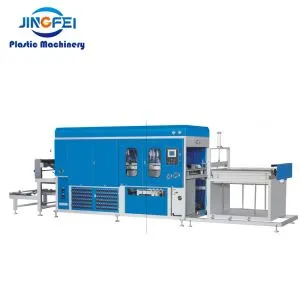
JH711/1200-A Automatic Vacuum forming machine with big forming area is designed by the principle of mechanical-electrical-pneumatic integration. It adopts PLC control system, panel and digital power control.

Thermoforming Vacuum Packaging Machine
JH700/1200-ASemi -Automatic Vacuum forming machine mainly use for plastic sheet forming, and cutting, it is suitable for make the big plastic trays and depth plastic products, like seed nursery tray, egg trays etc. it need extra cutting machine as auxiliary equipment

Automatic Vacuum Forming Machine
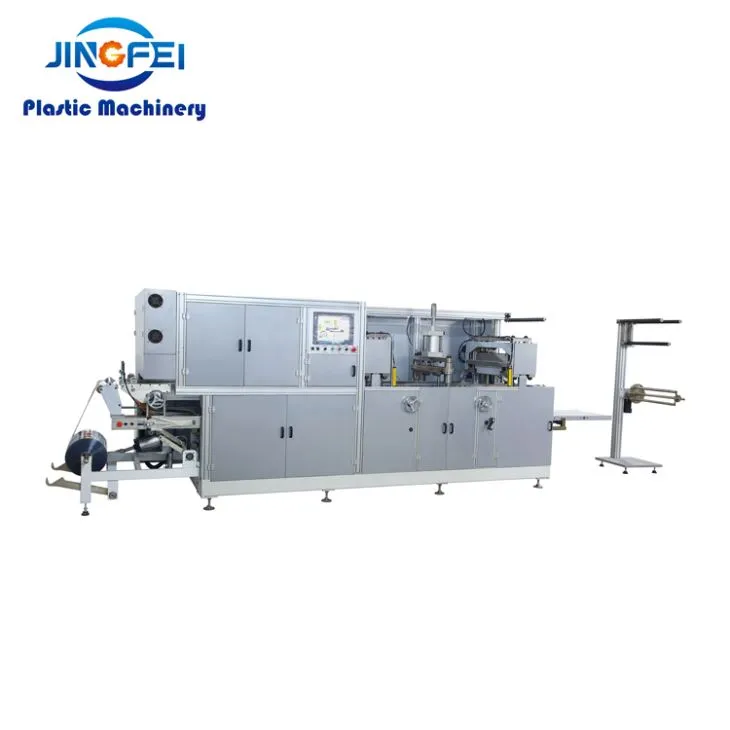
JH700/1200 Plastic Sheet Vacuum forming Machine this machine use PLC control, touch screen control,feeding the sheet, heating, forming, cooling, take the sheet out of mold and cutting, use famous pneumatic control system, working stable, and easy for operation.

Feeding the material by induction motor & feeding error within 4mm. Length set can be realized by programming on panel, expediently and precisely.

Plastic Vacuum Molding Machine
It is suitable for forming PS, HIPS, PVC, PET, PP, flocking sheet that can produce varieties of blister package and blister tray. For example: curatorial injection tray, oral liquid tray, mobile telephone tray, cookies tray, one-off tableware etc...

Industrial Vacuum Forming Machine
Installation & commission: if the buyer need our engineer to installation and adjusting, the buyer should supply the air ticket come and back, hotel and meal and interpreter service, if the buyer can't supply the interpreter, you need afford two people cost. The commission 80USD/DAY.
What is Industrial Vacuum Forming Machine
Industrial vacuum forming machines are used for high-volume production runs to successively manufacture detailed plastic products and parts. They vary considerably in terms of size, complexity, and production capabilities.
Modern, computerized thermoformers combine techniques drawn from mechanical and electrical engineering. Some machines are manually operated, and others are semi-automatic or fully automatic.
A single heater machine has an overhead oven that heats the material from one side. Whereas a double heater machine has a top and bottom oven that simultaneously heats both sides of the plastic.
Advantages of Industrial Vacuum Forming Machine
Flexibility
Plastic forming vacuum machines can quickly adjust production processes and molds to meet different customer needs, enabling diverse product customization. Whether for complex shapes or small batch personalized orders, Industrial Vacuum Forming Machine can complete them efficiently.
Efficient Production
Compared to traditional injection molding, Industrial Vacuum Forming Machine have shorter production cycles, allowing for faster product forming and processing. For companies that need to respond quickly to market demands, Industrial Vacuum Forming Machine are crucial for enhancing production efficiency.
Cost Advantages
In customized production, mold costs are often a significant challenge for companies. Industrial Vacuum Forming Machine have relatively low mold manufacturing costs and fast mold change speeds, effectively reducing production costs. Additionally, their high material utilization rate minimizes material waste during production.
Quality Assurance
Commercial vacuum form machines achieve high-precision forming processes, ensuring the quality and consistency of each customized product. Advanced control systems can monitor various parameters in real-time during production, adjusting processes as needed to ensure high-quality output.
Application of Industrial Vacuum Forming Machine
Within the agricultural industry, the process of vacuum forming is regularly used to create plastic components for both transportation vehicles and heavy-duty machinery, as these vehicles and machinery are intended for long-term outdoor use. They need to be tough, durable, and weather-resistant, which is why vacuum formed parts offer the perfect solution.
Air travel requires interiors that are durable, easy to sanitise and fire resistant. The lightness of thermoformed plastics also helps reduce fuel consumption, which is why you'll see thermoformed products in features such as overhead storage bins, lighting fixtures, and armrests.
Vacuum formed plastics are used within the automotive industry for both aesthetic and functional purposes. The vacuum thermoforming process is used to produce an array of automotive items, including car dashboards and door panels, producing lightweight and cost-effective products. With a wide range of finishes available, they can be tailored to fit the style of any vehicle.
Plastic thermoformed products are widely used in the medical industry as they reduce the need for sterilisation and cleaning times, creating high quality products which are extremely durable. Examples of these include mobile X-ray equipment, hospital carts and tabletops used by patients and staff.
The construction sector uses the industrial vacuum forming process to manufacture parts for a range of construction equipment, such as supply and storage sheds, toolboxes, engine covers and interior components. Due to the nature of the construction industry, it's important that these elements are high scratch resistance, durable and waterproof, while offering a long service life with low maintenance.
How Industrial Vacuum Forming Machine Work



Initial Setup
Every machine has a perforated forming surface (platen) that holds the mold in place and a clamping frame that holds the plastic sheeting.
Before vacuuming can begin, the mold is fastened to a board-like platform, which in turn gets fastened to the platen.
Next, the mold is lowered or raised into the clamps holding the plastic sheet. The frames are then adjusted or changed out to accommodate the size of the mold.
Heating
Once the plastic sheeting is loaded into the machine and the heater(s) are positioned, the material is sent through the oven(s) at increasing temperatures and time intervals.
A pyrometer monitors and adjusts the material's temperature as it passes through several heating zones.
Some machines are equipped with a photo-electric beam that gets projected into the heating chamber to keep the plastic level. If the material starts to sag, pressurized air is blown into the oven to lift it back to the correct position.
When the plastic reaches the predetermined forming temperature, it is smoothed out to an even consistency.
Vacuuming and Forming
After the plastic is rotated out of the heater and into the forming station, the platen lifts (or lowers) the tool into the plastic.
When needed, a plug assist will push extra material further into the mold so it reaches the deepest areas of the part.
An external vacuum pump is then activated to suction the sheeting around the mold and remove the air trapped between the mold and plastic. This causes the material to pull against the mold and take shape.
Cooling
The cooling process is done gradually and consists of several stages.
As the tooling comes out of the machine, its temperature is regulated by a computerized control unit.
While the vacuum is still on, internal high-speed fans cool the newly created part until it becomes solid. This process will be accelerated if a mold has internal water lines.
When the part has properly cooled, the vacuum stops and compressed air is pumped through the mold. The platens are then taken away and the object is removed from the mold.
Lastly, the machine rotates the part into the loading station where it is given additional time to cool before being trimmed.
Type of Industrial Vacuum Forming Machine
Manual Vacuum Forming Machines
Manual vacuum-forming machines are characterized by their simplicity and affordability, making them suitable for small-scale operations and prototyping. These machines typically feature a basic frame, a heating element, and a manual control interface. Operators manually position the thermoplastic sheet over the mold and activate the vacuum system to form the material. While manual machines offer a low-cost entry point into vacuum forming, they may lack the precision and efficiency of their automated counterparts.
Semi-Automatic Vacuum Forming Machines
Semi-automatic vacuum-forming machines bridge the gap between manual and fully automatic models, offering enhanced efficiency and control. These machines incorporate semi-automated features such as motorized sheet feeding and mold indexing, reducing manual intervention and improving production consistency. Semi-automatic machines are well-suited for medium-volume production runs where a balance between cost-effectiveness and automation is desired.
Fully Automatic Vacuum Forming Machines
Fully automatic vacuum-forming machines represent the pinnacle of automation in vacuum-forming technology. These advanced systems feature integrated heating, forming, cooling, and trimming processes, operated through programmable logic controllers (PLCs) or computer numerical control (CNC) systems. Fully automatic machines offer unparalleled production speed, accuracy, and repeatability, making them ideal for high-volume manufacturing environments.
Heating the Thermoplastic Sheet
We start the Industrial Vacuum Forming Machine by heating a thermoplastic sheet. This plastic sheet gets soft and flexible under heat. The temperature must be just right-hot enough to mold but not so hot that it melts.
Placing the Sheet over the Mold
The heated thermoplastic sheet becomes soft and pliable. We must quickly place it over the mold. This step is crucial to ensure the plastic fits perfectly around every contour of the mold.
Next, we make sure the sheet covers all areas evenly. An uneven placement can cause defects in the final product. Industrial Industrial Vacuum Forming Machine often have automated systems to help with this precision, making our job easier and more efficient.
Creating the Vacuum
We place the heated sheet over the mold. Next, we create a vacuum to shape it. This step is crucial for forming precise shapes in automotive and industrial applications.
We use specialized pumps to remove air between the plastic sheet and the mold. This causes the material to conform tightly around all details of the mold. Vacuum forming technology is valuable here because it ensures sharp angles and complex curves fit well-key features for detailed parts like car dashboards or equipment housings.
Cooling and Solidifying
Cooling is crucial in vacuum forming. After shaping, the plastic must harden to maintain its form. Air cools it quickly, and fans can help speed up the process.
Solidifying ensures that parts stay strong and durable. We use cooling systems to prevent warping or bending during this stage. Proper cooling results in high-quality products for industrial and automotive applications.
Trimming and Finishing
Trimming and finishing are crucial steps in vacuum forming. We start by removing excess material from the formed part with precision tools. This ensures accurate shapes matching detailed industrial and automotive requirements.
Next, we focus on finishing to smooth out edges and surfaces. Techniques like sanding or polishing guarantee a high-quality final product. These steps enhance the durability and look of thermoformed parts used across industries such as manufacturing, electronics, and medical sectors.
What are the Differences Between Vacuum Forming, Thermoforming, and Pressure Forming
Thermoforming is a manufacturing process where a sheet of plastic is heated to become pliable, then shaped or contoured using a mold, and trimmed to create a final part or product. Vacuum forming and pressure forming are two of the most popular types of thermoforming processes. The main difference between vacuum forming and other thermoforming processes is the methods used to form the parts and the number and type of molds that are used.
Vacuum forming is the simplest type of plastic thermoforming, that uses one mold and vacuum pressure to obtain the desired part geometry. It is ideal for parts that only need to be precisely formed on one side, such as contoured packaging for food or electronics.
There are two basic types of molds-male or positive (which are convex) and female or negative, which are concave. With male molds, the sheet of plastic is placed over the mold to contour the inside dimensions of the plastic part. With female molds, the thermoplastic sheet is placed inside the mold to form the outer dimensions of the part precisely.
In pressure forming, a heated sheet of plastic is pressed (hence the name) between two molds instead of being pulled into place around a single mold using suction. Pressure forming is ideal for manufacturing plastic parts or pieces that need to be more precisely shaped on both sides and/or require a deeper draw (they need to extend farther/deeper into a mold), such as appliance casings that need to look aesthetically pleasing on the exterior and snap into place or fit a precise size on the interior side.
Our mainly products is PP-550 Automatic Thermoforming Machine. This machine is Our technical innovated according to the marketing request. This machine could automatically feeding the sheet,heating,forming, punching,cutting, stacking and waste reclaiming. Forming ,punching and cutting are work independent.Forming and cutting are control by separate servo motor,both top mold and bottom mold are movement during the work, it could make double gulge productes like egg trays.
FAQ
Hot Tags: industrial vacuum forming machine, China, manufacturers, suppliers, factory, customized, price, used vacuum forming machine, extruder manufacturer, Single Screw Plastic Granul Extruder Line, thermoformer parts, Plastic Sheet, vacuum forming mould